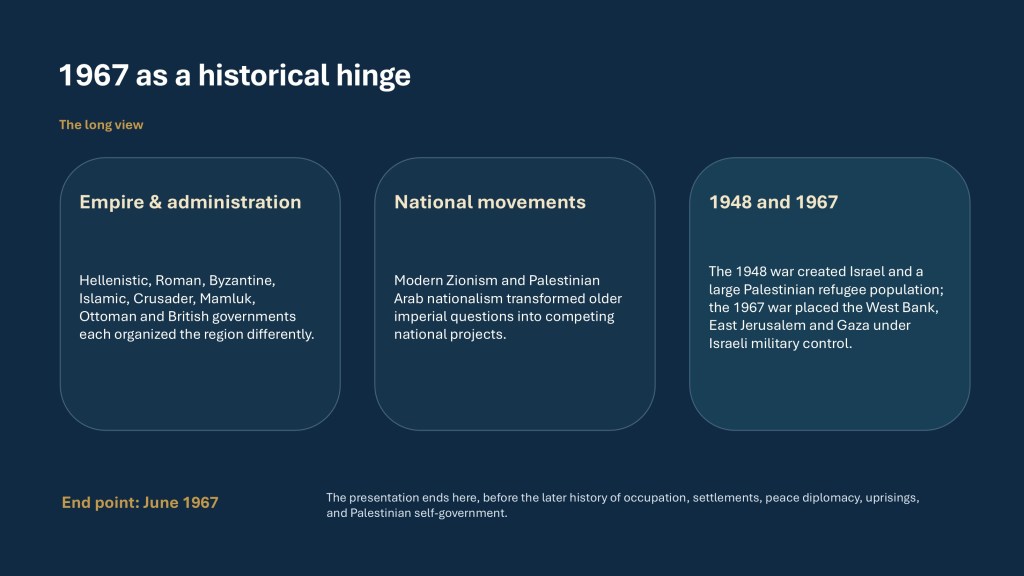
The presentation below is a chronological overview of Palestine from Alexander’s conquest around 332 BCE to the Six-Day War in June 1967, followed by an appendix on attacks against Israel through 2025. Its main claim is that “Palestine” is a geographic and administrative name whose borders and political meaning changed with each ruler.
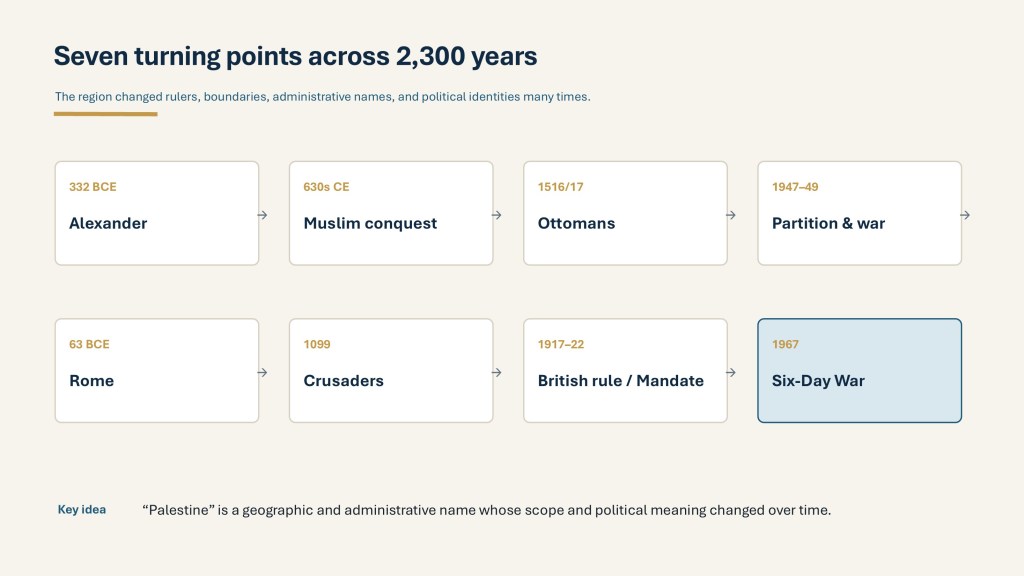
The historical core runs through seven turning points.
– **Hellenistic period, about 332–63 BCE.** Alexander took the region from the Persians. Ptolemies and Seleucids then competed for it, and the Maccabean revolt produced the Hasmonean kingdom.
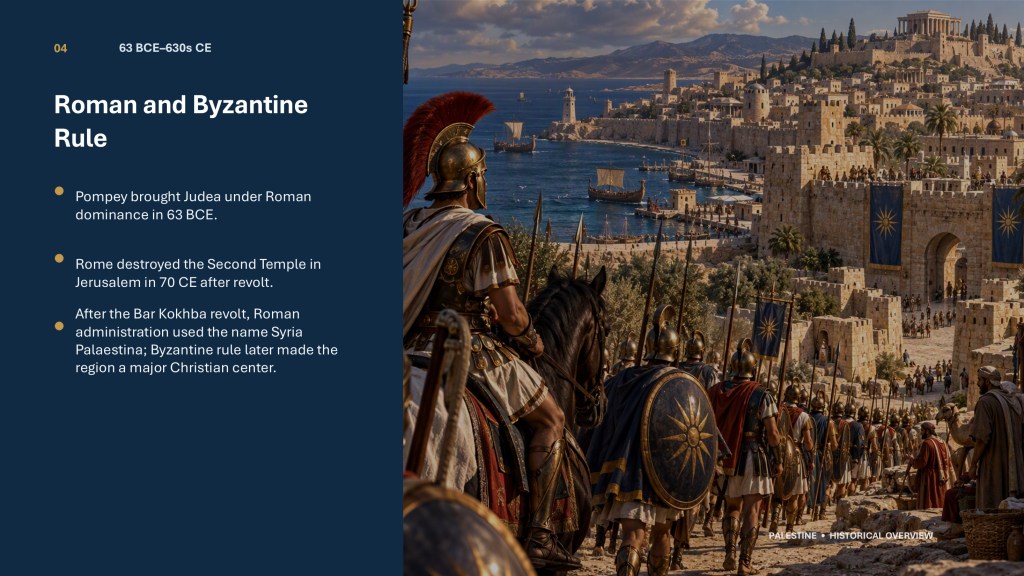
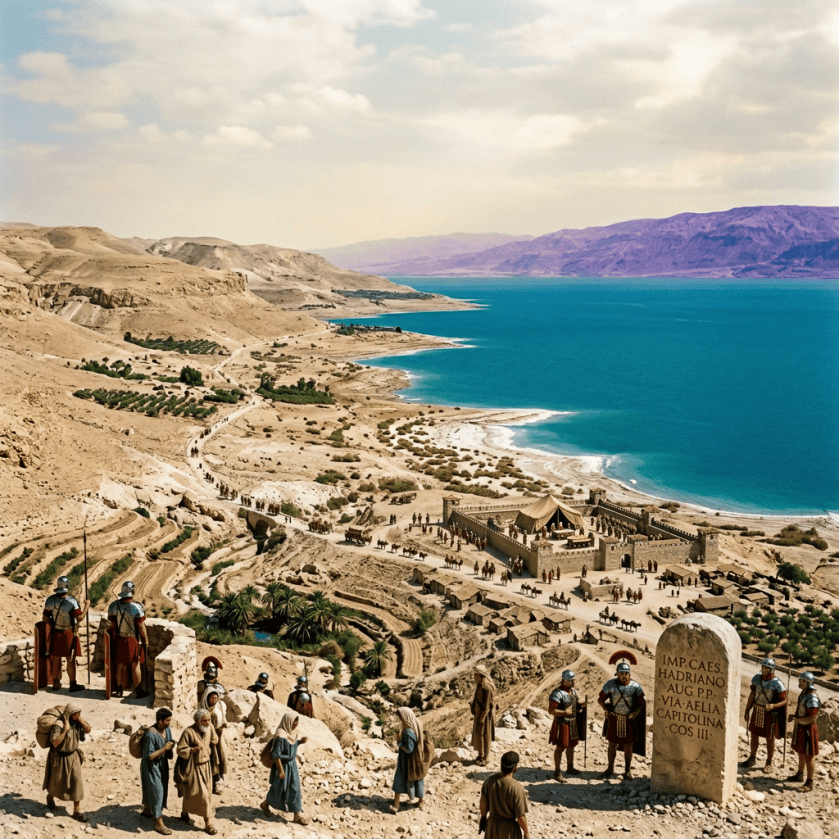
– **Roman and Byzantine rule, 63 BCE–630s CE.** Pompey brought Judea under Rome. The Second Temple was destroyed in 70 CE. After the Bar Kokhba revolt, Roman administration used the name Syria Palaestina. Under Byzantium the region became a major Christian center.
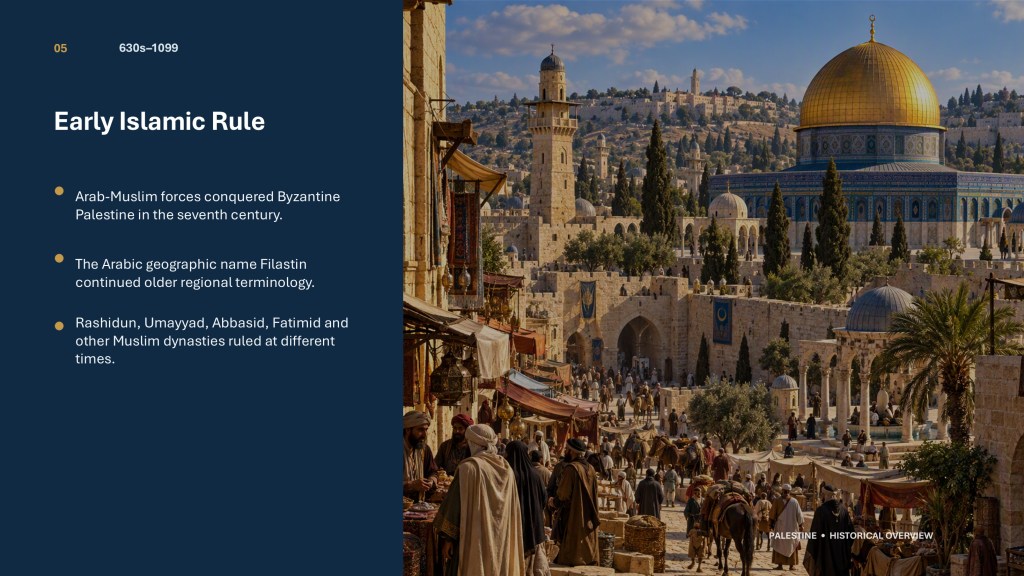
– **Early Islamic rule, 630s–1099.** Arab-Muslim armies conquered Byzantine Palestine. The Arabic name Filastin continued older regional terminology. Rashidun, Umayyad, Abbasid, Fatimid, and other dynasties ruled in turn.
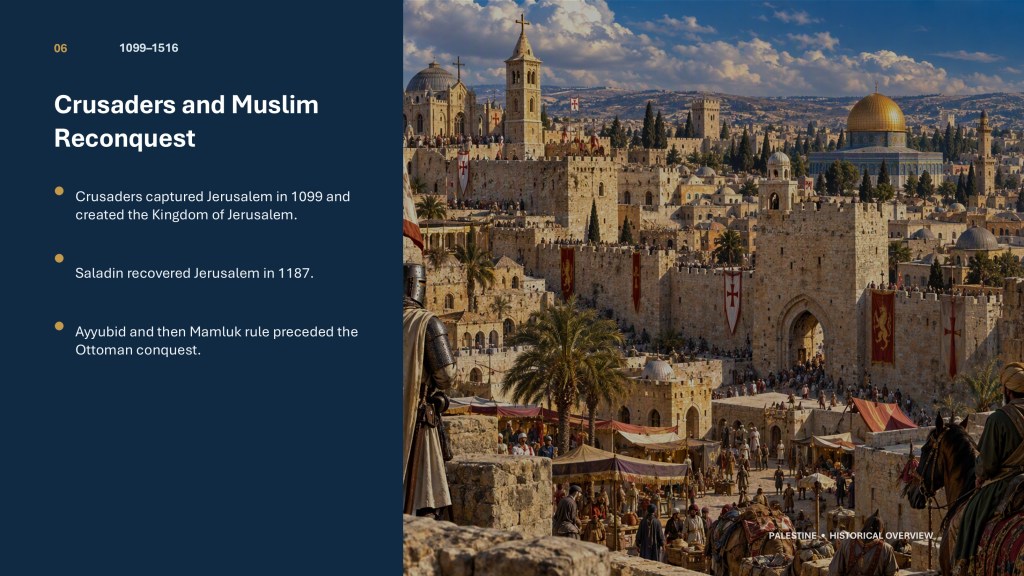
– **Crusaders and reconquest, 1099–1516.** Crusaders took Jerusalem in 1099 and founded the Kingdom of Jerusalem. Saladin recovered the city in 1187. Ayyubid and then Mamluk rule preceded the Ottomans.
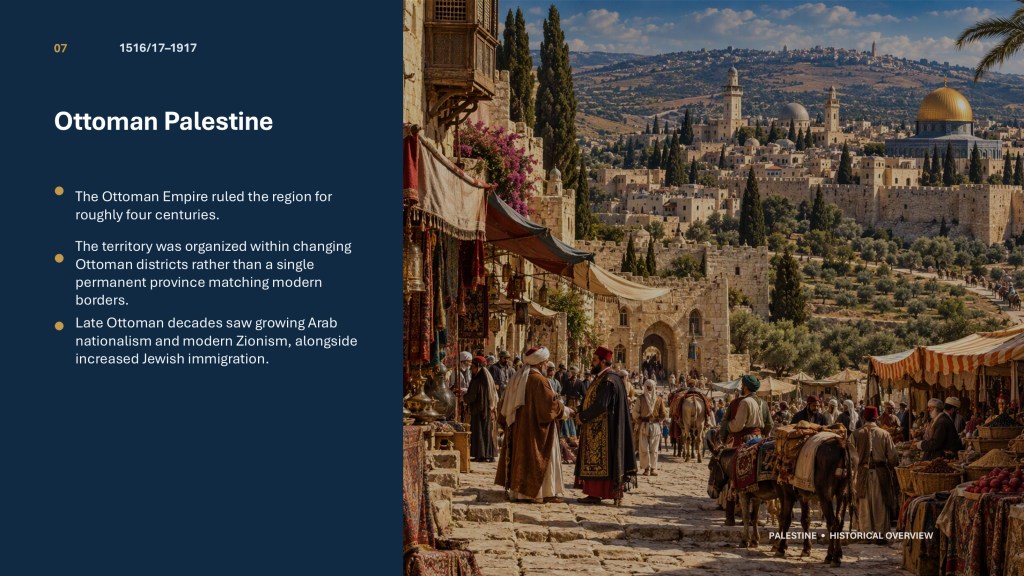
– **Ottoman Palestine, 1516/17–1917.** Four centuries of rule organized the land in changing districts, not as one permanent province matching modern borders. Late Ottoman decades brought Arab nationalism, modern Zionism, and increased Jewish immigration.
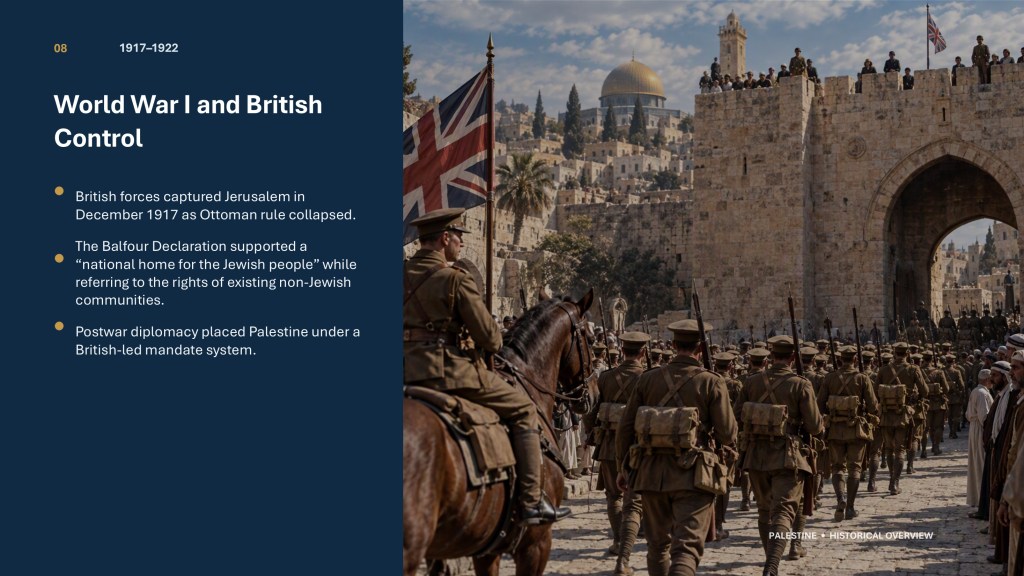
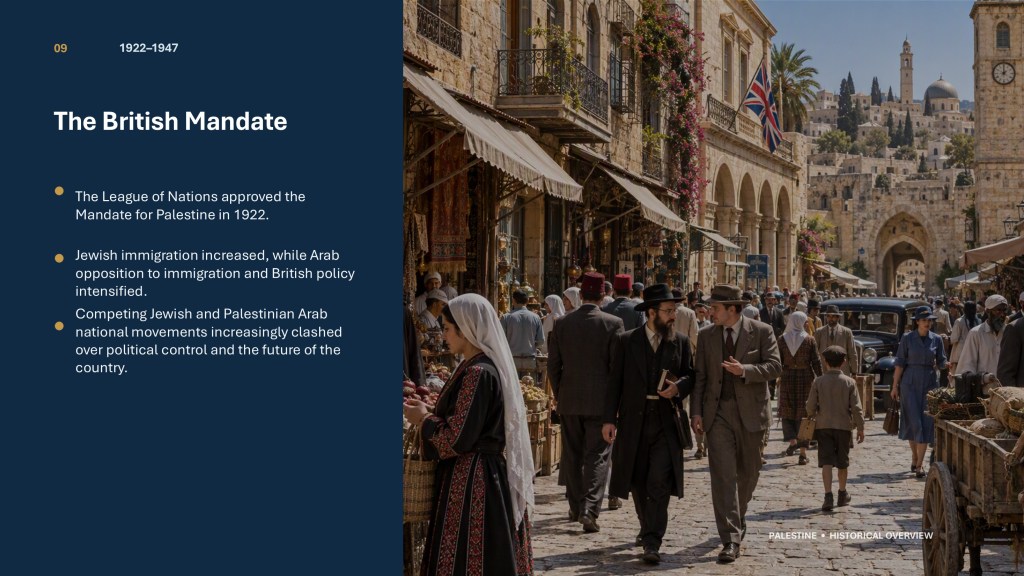
– **British control and the Mandate, 1917–1947.** Britain captured Jerusalem in December 1917. The Balfour Declaration supported a Jewish national home while referring to the rights of existing non-Jewish communities. The League of Nations Mandate of 1922 oversaw rising Jewish immigration, Arab opposition, and a clash between two national movements.
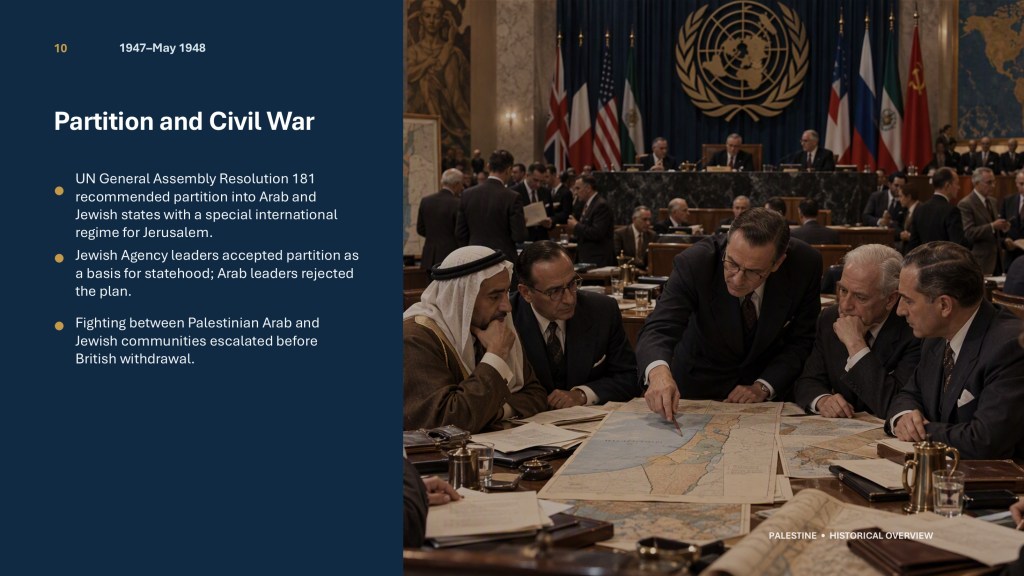
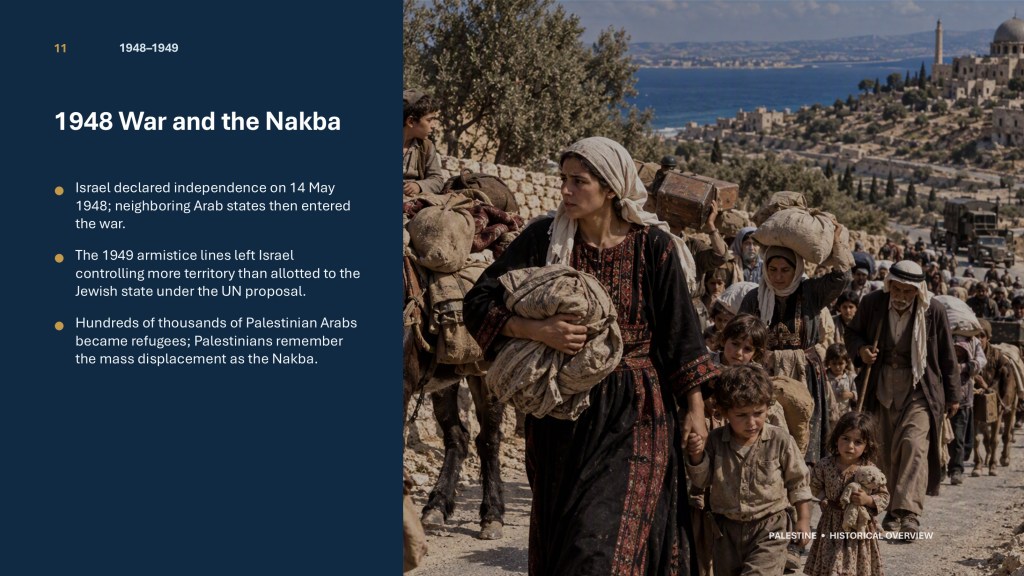
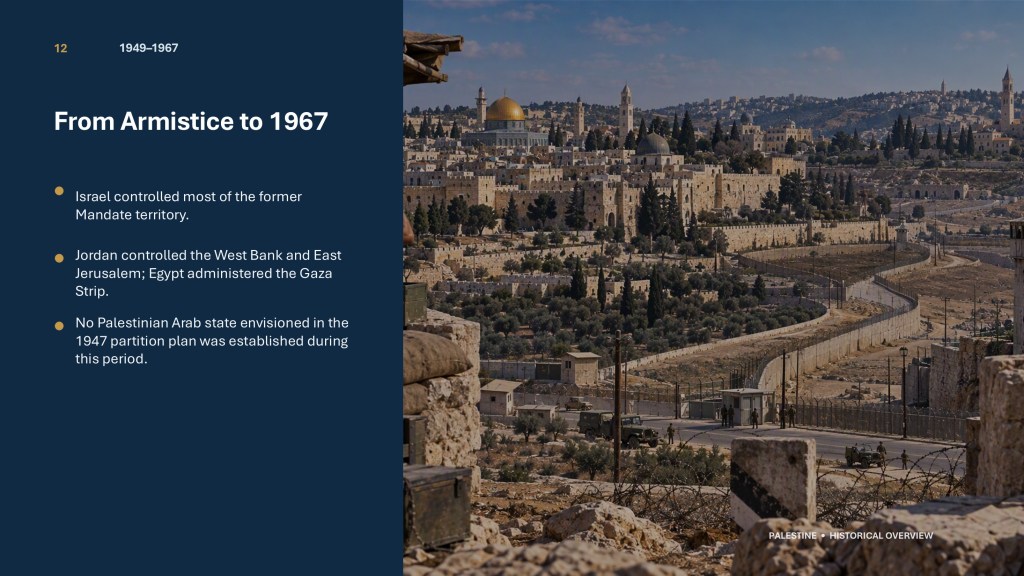
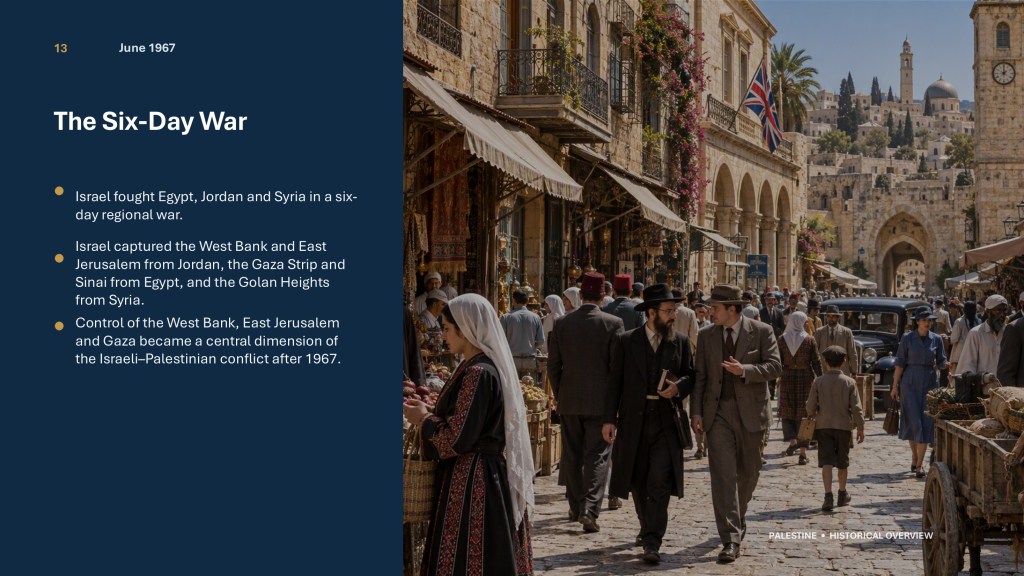
– **Partition, 1948, and 1967.** UN Resolution 181 recommended partition into Arab and Jewish states, with an international regime for Jerusalem. Jewish leaders accepted it as a basis for statehood; Arab leaders rejected it. Israel declared independence on 14 May 1948, and neighboring Arab states entered the war. The 1949 armistice left Israel with more territory than the UN plan had allotted the Jewish state. Hundreds of thousands of Palestinian Arabs became refugees, remembered as the Nakba. From 1949 to 1967 Jordan held the West Bank and East Jerusalem, Egypt administered Gaza, and no Palestinian Arab state was established. In June 1967 Israel captured the West Bank and East Jerusalem from Jordan, Gaza and Sinai from Egypt, and the Golan Heights from Syria.
The narrative stops at June 1967, before occupation, settlements, diplomacy, uprisings, and Palestinian self-government.
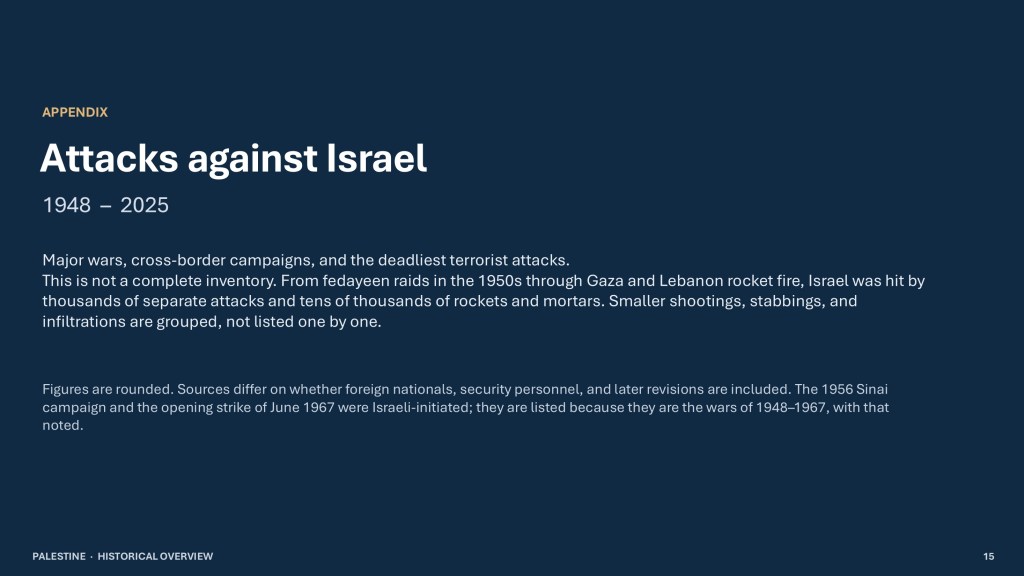
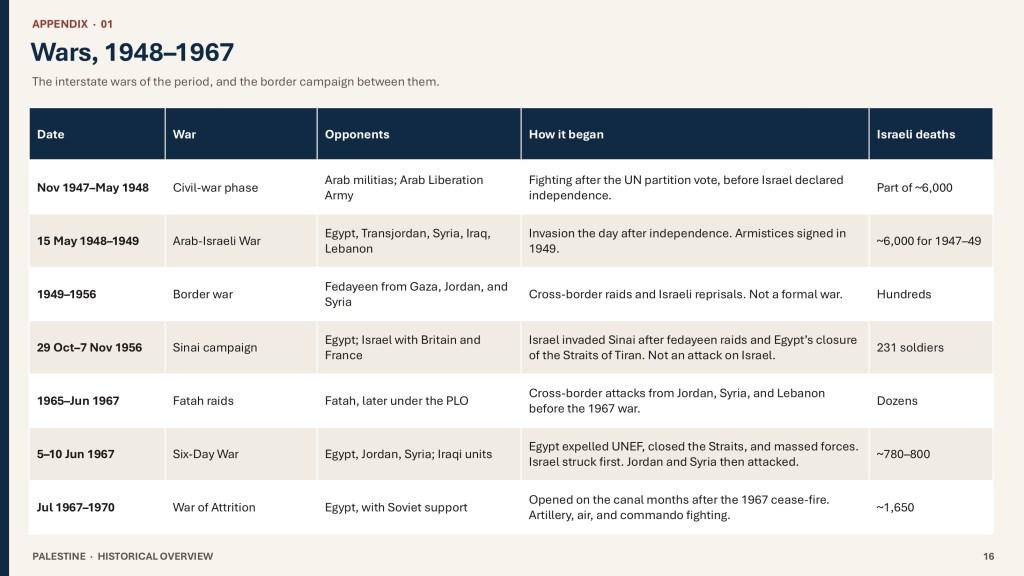
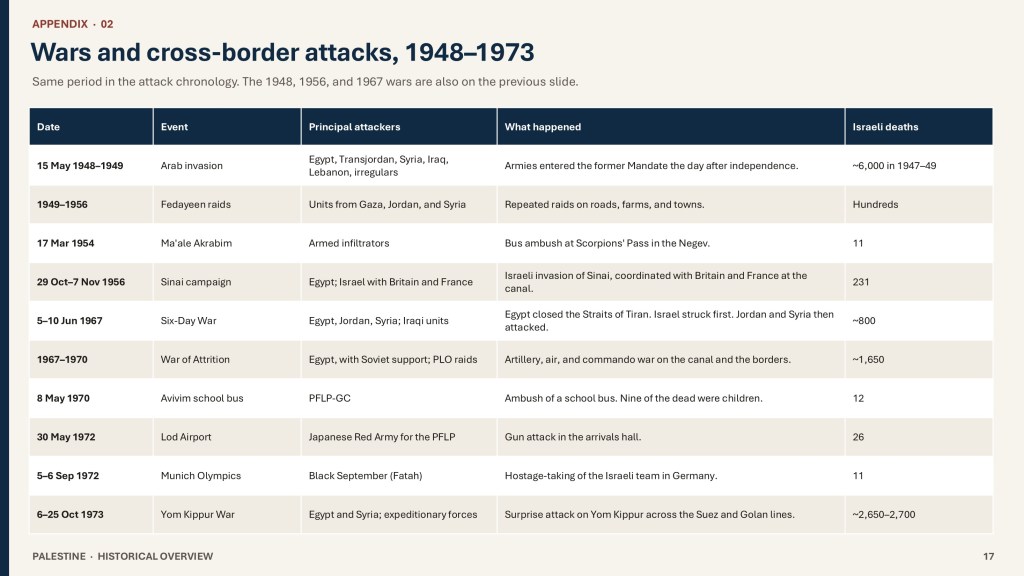
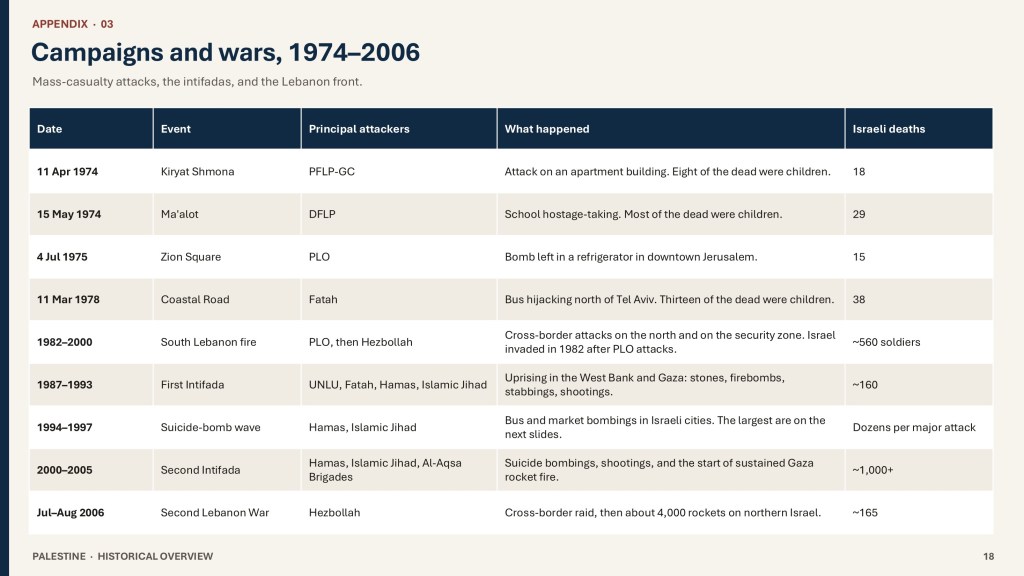
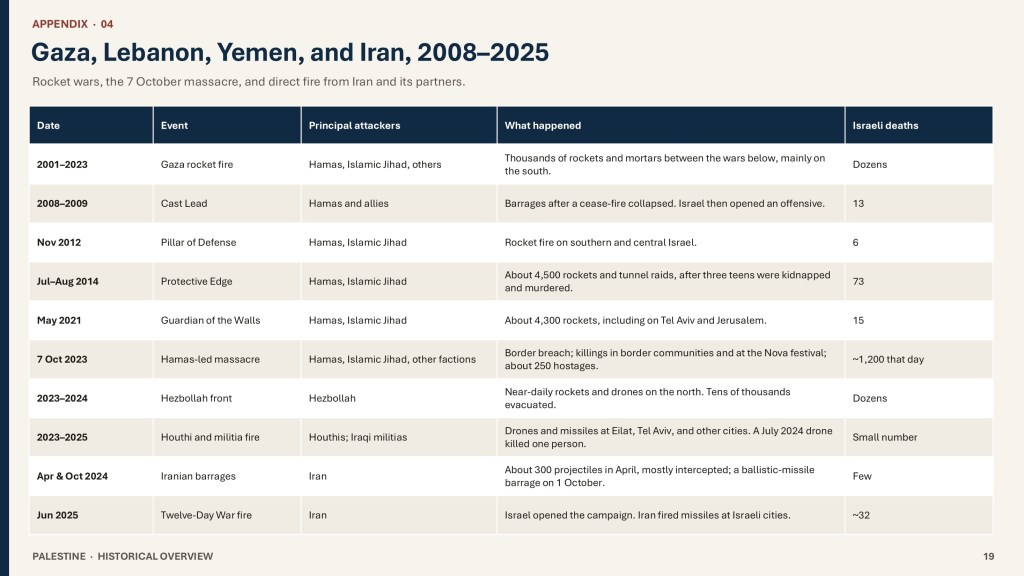
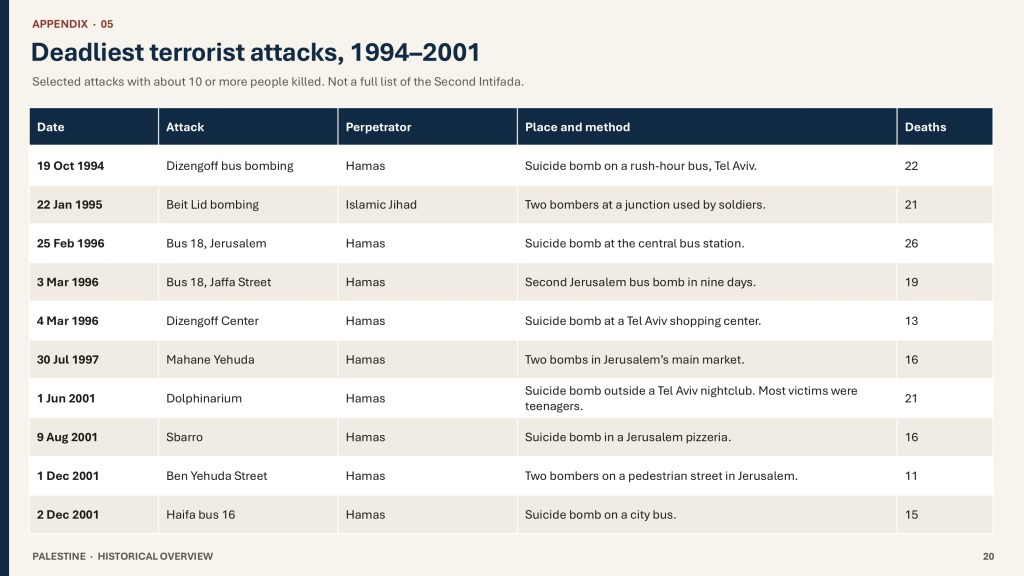
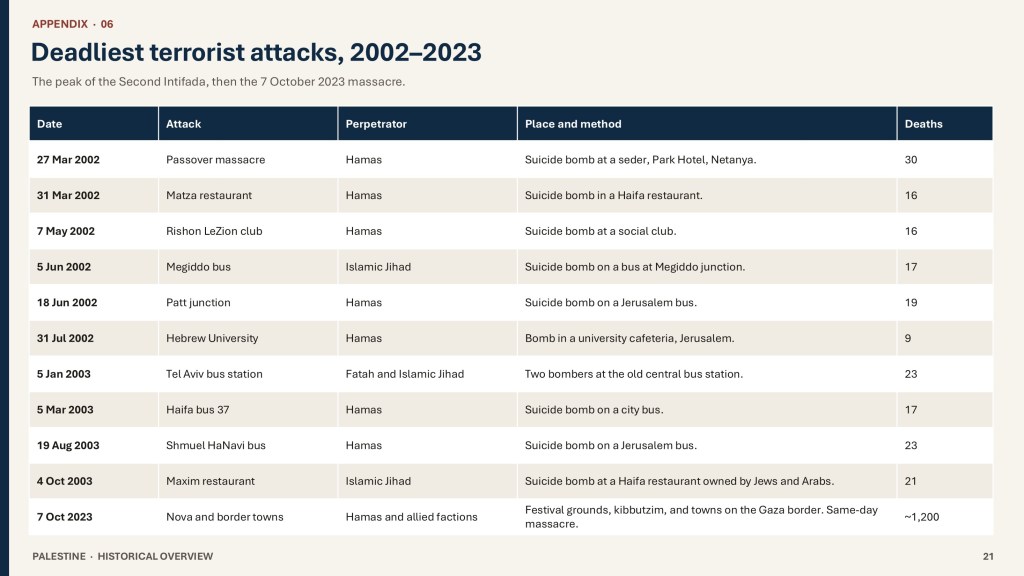
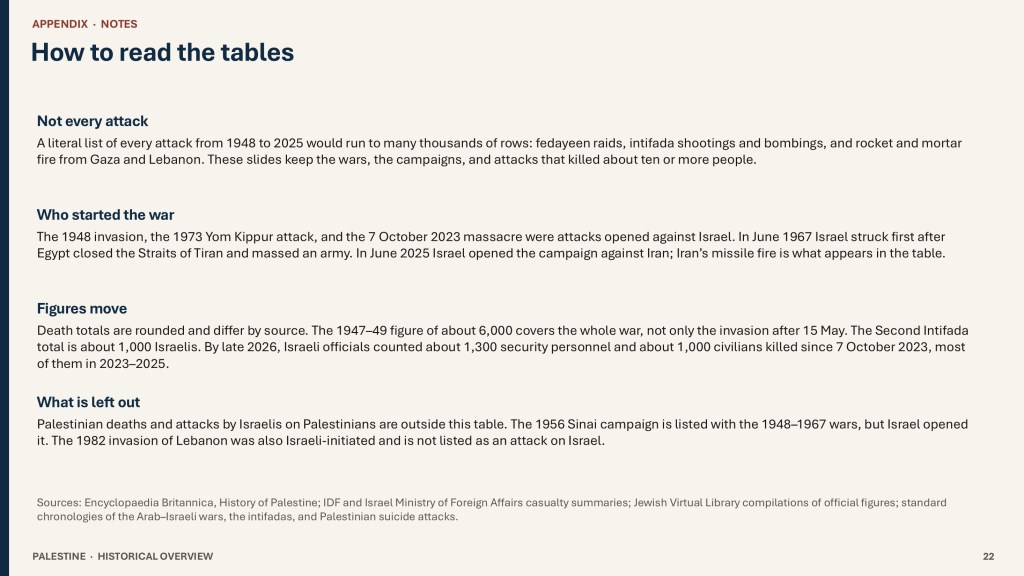
The appendix, slides 15–22, is a separate chronology of wars and attacks against Israel from 1948 to 2025. It is not a complete inventory. It lists interstate wars, border campaigns, and attacks that killed about ten or more people, with rounded Israeli death figures. It notes that Israel opened the 1956 Sinai campaign and struck first in June 1967 after Egypt closed the Straits of Tiran, and that Israel opened the June 2025 campaign against Iran. Palestinian deaths and attacks by Israelis on Palestinians are explicitly left out of those tables.