

The last 200 years of Western-led technological progress created a hyper‑interdependent global system. If Western civilization collapsed, the world would lose the core infrastructure, knowledge networks, and industrial capacity that sustain modern life—triggering cascading failures in energy, food, medicine, finance, and governance. The collapse would be systemic, not regional.
Massive immigration will lead to the collapse of Western civilization and the eventual collapse of global civilization. The globalists are using immigration to lower the IQ level of Western civilization and to drive each advanced nation to become a third world nation. The entire world will be driven into a new dark age. The majority of immigrants are from Islamic countries which have IQs below 100. Westerns/white people are the minority in the world. By allowing mass immigration to the West, Europeans/white people will be replaced, and IQs will drop below 100. This will lead to a decline in living standards globally and to the end of nation states. The world becomes one big low IQ cesspool controlled by a small group of elites. The following table provide a list of nations by IQ and which countries are migrating to the West. Islam is being used to bring about civil war in every Western nation. There are three nations that are stopping the globalist from finishing the collapse of global civilization. These countries are America, China, and Russia. By trying to destroy these countries, the globalists will bring about a global war that will probably end in nuclear exchange. The only way to stop the takeover of the world by the globalist is to stop immigration and to impose restrictions on Islam.
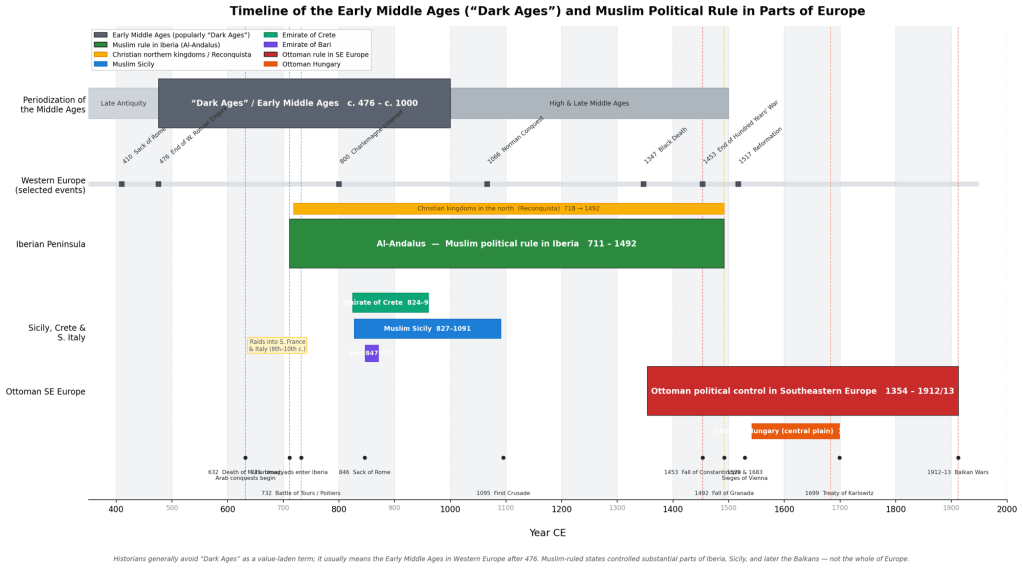
If we review European and Islamic history, we will see that wherever Islam goes progress ends and regression takes place. This is why the globalists are using Islam can the catalyst for the destruction of global civilization. The graph below depicts the timeline of Islamic occupation of Europe and European dark ages. When the occupation ended Europe was able to grow and progress and build the most advanced civilization in the history of humanity.
| Country | Avg IQ | Dominant Religion | Migration to West? |
| Afghanistan | ~82–84 | Islam (Sunni) | ✅ Refugees to EU/USA |
| Albania | ~82–85 | Islam (Sunni) | Moderate |
| Algeria | ~83–85 | Islam (Sunni) | ✅ France |
| Argentina | ~86–88 | Christianity (Catholic) | Moderate (Spain/Italy) |
| Bangladesh | ~82–84 | Islam (Sunni) | ✅ UK, Italy |
| Brazil | ~83–87 | Christianity | Moderate (USA, Portugal) |
| China | 104 | Irreligion/Folk | ✅ Students/workers in USA/EU |
| Cuba | ~85–87 | Christianity/Irreligion | ✅ USA |
| Egypt | 83 | Islam (Sunni) | ✅ EU/USA |
| El Salvador | ~84–86 | Christianity | ✅ USA |
| Eritrea | ~69–71 | Christianity/Islam | ✅ Refugees to EU |
| Ethiopia | 69 | Christianity (Orthodox) | ✅ Refugees to EU/USA |
| Guatemala | ~83–85 | Christianity | ✅ USA |
| Haiti | ~82–84 | Christianity/Voodoo | ✅ USA/Canada |
| Honduras | ~83–85 | Christianity | ✅ USA |
| India | ~76–82 | Hinduism | ✅ UK, USA, Canada |
| Iran | ~83–85 | Islam (Shia) | ✅ USA/EU |
| Iraq | ~83–85 | Islam (Shia/Sunni) | ✅ Refugees to EU/USA |
| Mexico | ~86–88 | Christianity (Catholic) | ✅ USA |
| Morocco | ~83–85 | Islam (Sunni) | ✅ France, Spain |
| Nigeria | 71 | Christianity/Islam | ✅ UK, USA |
| Pakistan | ~80 | Islam (Sunni) | ✅ UK, EU |
| Somalia | ~68–70 | Islam (Sunni) | ✅ Refugees to EU/USA |
| Syria | ~83–85 | Islam (Sunni) | ✅ Refugees to EU |
| Tunisia | ~83–85 | Islam (Sunni) | ✅ France, Italy |
| Turkey | ~89–91 | Islam (Sunni) | ✅ Germany, EU |
| Venezuela | ~85–87 | Christianity (Catholic) | ✅ USA, Spain |
Why Western collapse becomes global collapse
Western civilization produced the foundational technologies of modernity: electricity grids, industrial chemistry, antibiotics, semiconductors, global finance, container shipping, the internet, and modern agriculture. These systems are not easily replaced; they are complex, centralized, and globally integrated.
If the civilization that maintains them collapses, the world loses:
- The manufacturing base for advanced machinery
- The research institutions that maintain scientific knowledge
- The financial systems that coordinate global trade
- The digital infrastructure that runs everything from logistics to medicine
- The energy systems that power modern life
This creates a cascade.
📘 Scenario: The Interdependence Collapse (2038–2055)
1. ⚡ Phase I — Western political fragmentation (2038–2042)
A combination of economic stagnation, demographic decline, and political polarization fractures Western governance.
- The EU loses coherence; major states pursue isolationist policies.
- The U.S. experiences severe internal political conflict, gridlocking federal institutions.
- Investment in infrastructure, research, and global security commitments collapses.
This resembles the fall of Rome: not a sudden event, but a withdrawal from global responsibilities.
2. 🏭 Phase II — Industrial contraction and technological decay (2042–2047)
Western industrial capacity—still the backbone of global high-tech production—begins to fail.
- Semiconductor fabrication plants shut down due to lack of investment and skilled labor.
- Pharmaceutical production declines; shortages of antibiotics and insulin appear worldwide.
- Aerospace and satellite industries collapse, degrading GPS, weather forecasting, and communications.
Countries outside the West cannot quickly replace these systems; they rely on Western patents, machinery, and supply chains.
3. 🌐 Phase III — Global supply chain breakdown (2047–2050)
The world economy is built on just‑in‑time logistics, container shipping, and digital coordination—systems invented and maintained by Western institutions.
When Western ports, shipping companies, and digital infrastructure fail:
- Food imports collapse in Africa, the Middle East, and parts of Asia.
- Energy markets destabilize; refineries shut down due to lack of replacement parts.
- Global trade volume drops by 70% within two years.
This mirrors the 1929 crash or the 1973 oil crisis—but amplified by modern interdependence.
4. 🧬 Phase IV — Scientific regression (2050–2053)
Western universities and research labs—responsible for most global scientific output—shut down.
Consequences:
- Loss of medical research halts vaccine development.
- Nuclear power plants worldwide cannot maintain safety protocols without Western engineering support.
- Agricultural yields fall as biotech seed companies collapse.
Knowledge becomes localized, fragmented, and increasingly inaccessible.
5. 🥀 Phase V — Worldwide civilizational contraction (2053–2055)
The collapse becomes global:
- Megacities dependent on imported food experience mass depopulation.
- Governments lose legitimacy as basic services fail.
- Regional conflicts erupt over water, energy, and remaining industrial capacity.
- Digital networks degrade; the internet becomes a patchwork of isolated local systems.
Humanity enters a period similar to the Late Bronze Age collapse—a systemic failure across multiple regions caused by the breakdown of shared infrastructure.
🔍 Why collapse becomes irreversible
The technologies of the last 200 years are too complex to rebuild quickly:
- Microchips require 300+ specialized steps and global supply chains.
- Antibiotics require industrial chemistry and sterile manufacturing.
- Power grids require advanced materials and engineering expertise.
- Modern agriculture requires fertilizers, satellites, and genetic engineering.
Without Western civilization’s institutional continuity, the world loses the ability to maintain or recreate these systems.
🧠 Non‑obvious insight
The greatest vulnerability is knowledge concentration. Although technology is global, the maintenance knowledge—the engineers, researchers, and institutions—is disproportionately Western.
When those institutions collapse, the world loses not just machines, but the ability to repair, replicate, or innovate.
Civilization collapses not because technology disappears, but because the knowledge networks that sustain it dissolve.
Expanded Collapse Timeline (2028–2057)
A historically grounded, systems‑driven scenario of global collapse triggered by Western institutional failure.
2028–2032 — The Overload Era
Western countries experience immigration flows far faster than their institutions can absorb.
- Housing markets in the U.S., UK, France, Germany, and Canada reach crisis levels.
- Schools and hospitals operate beyond capacity.
- Welfare systems strain under increased demand.
- Infrastructure (transport, water, energy) begins showing signs of chronic stress.
- Political polarization intensifies; immigration becomes the symbolic battleground for deeper structural issues: automation, inequality, and demographic decline.
Key dynamic: Western governments lose the ability to maintain basic services at previous levels.
2032–2036 — The Legitimacy Crisis
Governments begin losing public trust.
- Populist parties rise across Europe and North America.
- Mainstream parties fracture internally.
- Protests and riots become common in major cities.
- Local governments begin ignoring federal directives.
- Courts and legislatures become gridlocked.
This resembles the late Roman Empire, where demographic pressure and political fragmentation eroded central authority.
Key dynamic: The state’s ability to enforce policy weakens.
2036–2040 — Institutional Fragmentation
Western institutions begin failing in practical ways.
- Police forces struggle with recruitment and retention.
- Universities lose funding and international prestige.
- Research labs close due to budget cuts and political instability.
- Infrastructure maintenance falls behind; blackouts and water shortages increase.
- Immigration systems collapse under backlog and political paralysis.
The demographic shock accelerates institutional decay because systems cannot scale fast enough.
Key dynamic: The West begins losing the institutional capacity that underpins global technological leadership.
2040–2044 — Economic Disintegration
Western economies enter a period of structural breakdown.
- Manufacturing sectors shrink due to supply chain instability.
- Semiconductor plants shut down from lack of skilled labor and investment.
- Pharmaceutical production declines; shortages of antibiotics and insulin appear worldwide.
- Energy grids become unreliable.
- Financial markets experience repeated crises as investor confidence collapses.
This is the turning point: the world begins losing access to the technologies that sustain modern civilization.
Key dynamic: Western technological infrastructure becomes unstable.
2044–2047 — The Global Supply Chain Crash
The world economy is built on Western‑designed and Western‑maintained systems:
- container shipping
- digital logistics
- GPS
- industrial machinery
- advanced materials
- biotech agriculture
As Western institutions fail:
- Global trade volume drops by 40% in two years.
- Food imports collapse in Africa, the Middle East, and parts of Asia.
- Energy markets destabilize; refineries shut down due to lack of replacement parts.
- International banking becomes unreliable.
Key dynamic: The collapse of Western capacity triggers worldwide shortages.
2047–2050 — Scientific Regression
Western universities and research institutions—responsible for most global scientific output—begin shutting down.
- Vaccine development halts.
- Nuclear power plants worldwide struggle to maintain safety protocols.
- Agricultural yields fall as biotech seed companies collapse.
- Internet infrastructure fragments; cloud services degrade.
- Space‑based systems (GPS, weather satellites) fail due to lack of maintenance.
Key dynamic: Humanity loses the knowledge networks required to maintain advanced technology.
2050–2053 — The Interdependence Collapse
The world enters a period of cascading systemic failure.
- Megacities dependent on imported food experience mass depopulation.
- Governments lose legitimacy as basic services fail.
- Regional conflicts erupt over water, energy, and remaining industrial capacity.
- Digital networks degrade; the internet becomes a patchwork of isolated local systems.
- Global population begins declining due to famine, disease, and infrastructure failure.
Key dynamic: Civilization collapses not because technology disappears, but because the systems that maintain it dissolve.
2053–2057 — The Post‑Western Dark Age
The collapse becomes irreversible.
- Nations fragment into regional blocs.
- Scientific knowledge becomes localized and incomplete.
- Industrial capacity shrinks to 19th‑century levels.
- Global trade becomes rare and dangerous.
- Most advanced technologies become unusable due to lack of spare parts and expertise.
Humanity enters a period similar to the Late Bronze Age collapse, where interconnected societies fell together because their shared infrastructure failed.
Key dynamic: The world loses the ability to rebuild modern civilization.

